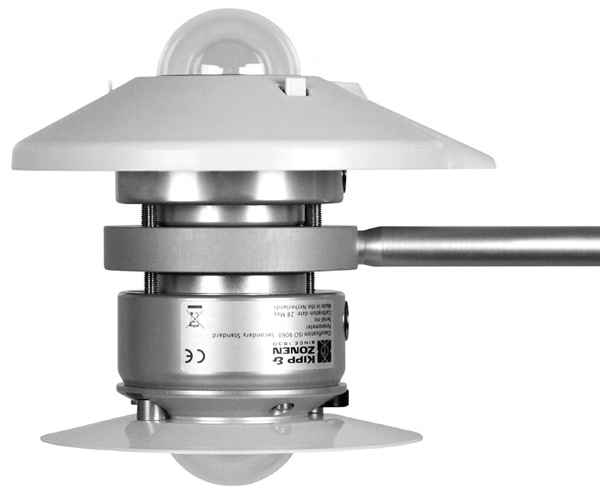
An albedometer is a high-precision meteorological instrument designed to determine the reflective properties of a surface by measuring the ratio of solar radiation across a 180° field of view. To achieve this, a central mounting fixture, often equipped with a glare screen to prevent interference, is used to hold two identical radiometers in a back-to-back configuration. The upward-facing sensor measures the Global Horizontal Irradiance (GHI) arriving from the sun and sky, while the downward-facing sensor captures the radiation reflected by the ground. By comparing these two simultaneous measurements in Watts per square meter (W/m²), researchers can calculate the “Albedo” of the surface, a dimensionless value between 0 and 1 that indicates how much solar energy is absorbed versus reflected back into the atmosphere.
While a standard albedometer typically utilises two thermopile pyranometers to measure the total solar spectrum, the instrument’s design is highly modular to suit specific research requirements. For instance, in advanced climate monitoring or building science, it is possible to construct specialised albedometers featuring dual Pyrgeometers to track longwave infrared radiation or dual UV Radiometers to monitor ultraviolet reflectivity. These variations are particularly critical when studying environments like polar ice caps or urban heat islands, where the reflectivity of specific wavelengths, such as the high UV reflection of snow or the thermal emission of asphalt, plays a significant role in local energy balances and environmental safety. By selecting different sensor pairings and utilising a universal mounting kit, a custom albedometer can be tailored to provide precise data for everything from agricultural optimisation to large-scale photovoltaic yield forecasting.
In the solar energy sector, albedo measurement has become a high-priority requirement due to the rise of bifacial modules. Unlike traditional panels, bifacial modules generate electricity from both the front (direct sun) and the rear (reflected light from the ground). Monitoring Albedo can show if changing to sand, grass or gravel may provide more energy to the rear panels and improve how much energy they generate. It can also be useful for knowing how snow could impact the energy produced.
Albedo is a fundamental variable in General Circulation Models (GCMs) and local weather forecasting. Meteorologists use albedo to calculate the “Net Radiation” of a region, determining how much the surface warms up during the day, influencing evaporation, convection, and cloud formation. Also, in polar and alpine regions monitoring snow and ice as it melts, or picks up more dirt can absorb more heat and melt faster, creating an ice-albedo feedback loop.
Measuring the albedo helps farmers to calculate how much irrigation their crops need as the amount crops lose through evapotranspiration is linked dirrectly to the solar energy they absorb. The colour and texture change in the canopy can also indicate the stage of growth, ripening or stresses from drought and disease.
Choose your pyranometers depending upon the ISO 9060 classification and signal output that you require. SP Lite2 and CMP3/SMP3 bolt together back-to-back with a screw-in mounting rod. Double-dome CMP/SMP pyranometers can be fixed to a CMF1 mounting plate and rod, or the larger CMF4 if you need CVF4 heating and ventilation units. For both configurations a glare screen for the lower pyranometer is available if required. A few options are shown below.
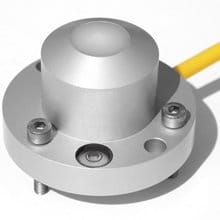
SP Lite2 uses a photodiode detector, which creates a voltage output that is proportional to the incoming radiation. Also due to the unique design of the diffuser, its sensitivity is proportional to the cosine of the angle of incidence of the incoming radiation, allowing for accurate and consistent measurements.
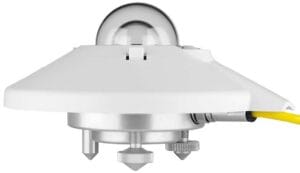
The CMP series pyranometers are well known around the world for their high quality, durability and accuracy. The instruments do not require any power and are ideal for remote sites with limited power availability or for field studies. Each has an individual calibration factor/sensitivity to convert the mV output signal to W/m2 of irradiance.
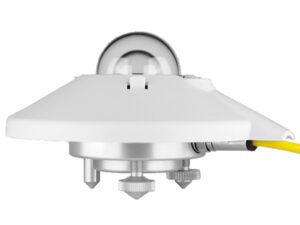
The SMP range of pyranometers is based on the proven technology of the CMP series, but has a micro-processor, memory and firmware that makes them Smarter and faster
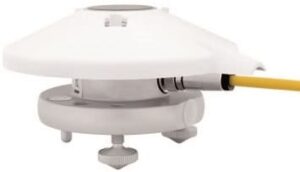
Pyrgeometers use silicon windows to transmit infrared radiation and these have an internal thin film coating that blocks short-wave solar radiation from reaching the broadband thermopile detector.
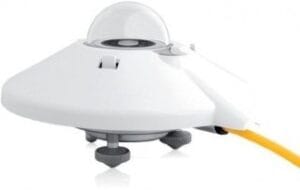
CUV5 and SUV radiometers are designed and calibrated to measure global ultraviolet (UV) solar irradiance.
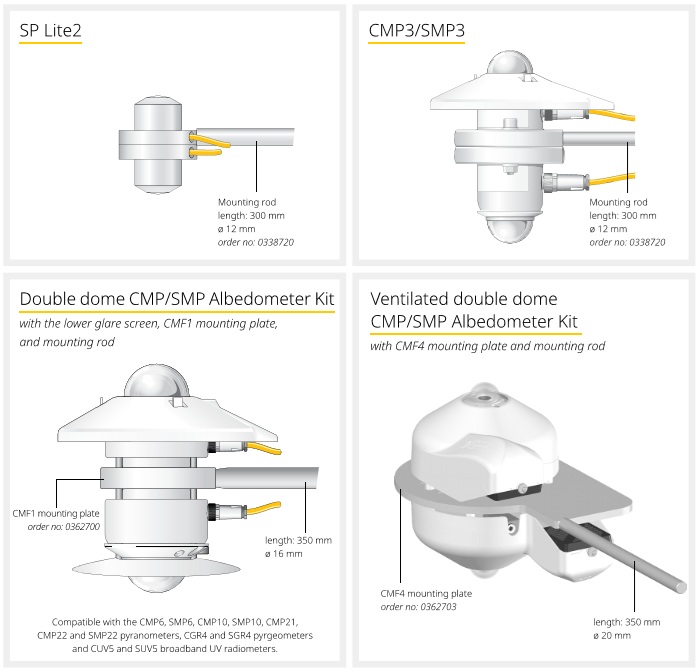
Add the mounting equipment from the options below,
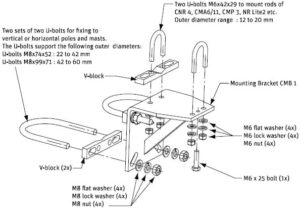
CMB 1 Mounting Bracket. This bracket is suitable for various mounting rod sizes, from 12mm to 20mm diameter, and can be secured via u-bolts to masts or poles from 22mm up to 60mm diameter. The bracket can also be secured directly to a wall, or other flat surface.
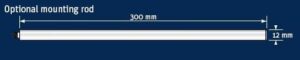
Mounting rod for Kipp & Zonen Pyranometer, Pygeometers and Radiometers sensor. The rod screws into the instrument housing to enable the attachment of the above instruments to poles, masts or walls when used in combination with the CMB 1 mounting bracket. The rod has a diameter of 12mm and a length of 300mm. Suitable for use with the SP-Lite 2, CMP series pyranometers, CGR3 and PQS1 sensors.
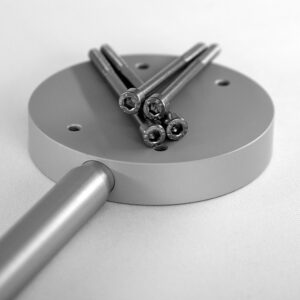
CMF 1 Mounting fixture has a 88mm diameter round plate with a non-removable mounting rod of 16mm diameter and 350mm long. Can be mounted to a pole or wall with the CMB 1 mounting bracket.
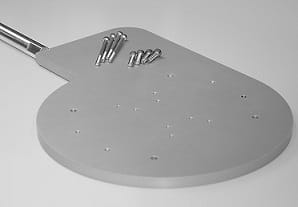
CMF 4 Mounting fixture has a 280mm diameter plate with a non-removable mounting rod of 20mm diameter and 350mm long. Can be mounted to a pole or wall with the CMB 1 mounting bracket. Suitable for ventilated radiometers.
A real person will answer the phone and deal with your enquiry.
You can also click the button below and fill in our online enquiry form.
Need help with your products or have a question for us on our custom systems? Use the form below to send us a message and our experts will be in touch to help.