Downloads
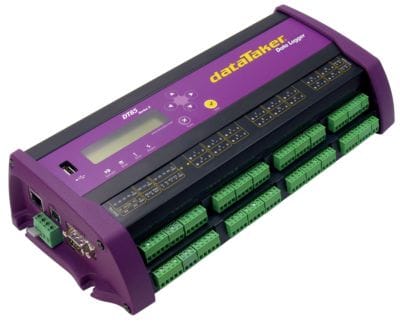
DT85 Series 4 Data Logger
Description
The dataTaker DT85 is the high-capacity “big brother” to the DT80. It features the exact same rugged build quality, low-power processing, internal dEX web software, and extensive communication capabilities as the DT80, but it is physically larger and packs significantly more native inputs.
If you are dealing with a project that requires tracking dozens of sensors simultaneously without immediately buying external expansion hardware, the DT85 is typically the go-to choice.
- Expanded Analogue Capacity
The most significant difference between the two models lies in the core analogue channel count. Using dataTaker’s unique “Dual Channel Isolation” layout, the DT85’s terminal board can be split into a much higher number of inputs:
- Common-Referenced (Single-Ended): Up to 48 inputs (sharing a common ground).
- Isolated Differential (2-wire): Up to 32 inputs.
- Isolated Differential (3-wire or 4-wire): Up to 16 inputs (ideal for complex RTDs, strain gauges, and full bridges).
Like the DT80, it features a high-precision 18-bit analogue-to-digital converter (ADC) that natively scales, linearises, and logs signals from thermocouples, thermistors, 4-20mA current loops, and DC voltages up to ±30V.
- Massive Scalability
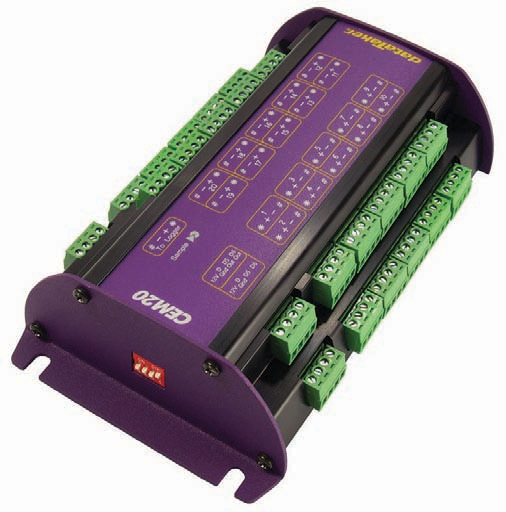
If the onboard 48 channels still aren’t enough, the DT85 shines in large-scale operations. By daisy-chaining external CEM20 (Channel Expansion Modules), a single DT85 master unit can scale up to support 960 analogue inputs, making it a highly cost-effective hub for massive industrial or structural monitoring sites.
- Digital, Pulse, and Smart Sensor Connectivity
The DT85 expands your digital utility slightly over smaller units:
- Digital Terminals: 12 flexible digital channels (compared to the DT80’s 8), which can be configured as logic state inputs, open-drain outputs, or pulse counters.
- High-Speed Counters: Dedicated high-speed counter inputs supporting frequencies up to 100 kHz for flow meters, wind speed sensors, and rotary/shaft encoders.
- Serial Networks: Dual serial “Smart Sensor” ports that run Modbus (Master/Slave), SDI-12 (great for multi-drop environmental strings), and raw ASCII protocols.
- Software, Storage, and Onsite Control
- No-Software Setup: It hosts the same browser-based dEX (or dEX 2.0) platform. You just plug into the logger over Ethernet or USB, load a web browser, and you can map out your sensors, script alarms, and configure dashboards.
- Data Logging & Offloading: Features internal non-volatile memory capable of holding roughly 10 million data points. You can plug a USB flash drive into the front panel to automatically mirror and dump data files without bringing a laptop into the field.
- Automated Data Delivery: It supports native FTP and email scheduling. If an alarm limit is breached (e.g., a structural temperature spikes), the logger can automatically email an alert or immediately push a data batch to your office server.
DT80 vs. DT85 Summary: Internally, they run the same brain, software, and programming logic. Choosing between them simply comes down to scale: if your sensor count is under 10–15, the DT80 keeps your footprint tight. If you are tracking a massive array of sensors or planning heavy future expansion, the DT85 is the appropriate hardware foundation.