
Description
The DataTaker DT80G is a rugged, low-power, standalone data logger designed specifically for geotechnical and specialised engineering applications. The “G” in the model name stands for Geotechnical, signifying its built-in support for vibrating wire sensors commonly used in civil engineering, mining, and structural health monitoring. DataTaker DT80G is specifically suited to geotechnical applications such as slope stability, subsidence, dam wall monitoring, tunnel and mining excavation, ground water, tunnel wall monitoring and site assessment. DT80G supports vibrating wire sensors and other geotechnical sensors.
An overview of its core capabilities, features, and technical specifications includes the following:
Key Geotechnical Focus
Unlike general-purpose DT80 data logger, the DT80G is tailored to interface directly with major geotechnical sensor brands (such as Geokon, RST Instruments, Slope Indicator, and Soil Instruments).
- Vibrating Wire Support: It has specialised onboard circuitry to pluck and read vibrating wire sensors (measuring strain, pressure, or displacement) over a frequency range of 500 Hz to 5 kHz.
- Capacity: It features 5 analogue channels capable of reading up to 5 vibrating wire sensors with temperature compensation (thermistors), or up to 15 vibrating wire sensors if temperature compensation isn’t required.
- Sensor Compatibility: Direct support for Extensometers, Piezometers, Inclinometers, Strain Gauges, Pressure Cells, Crack Meters, and Tiltmeters, as well as Carlson, Electrolevel, and LVDT devices.
Universal Analogue & Digital Channels
Beyond geotechnical sensors, the DT80G functions as a highly flexible universal logger:
- Analogue Inputs: Supports up to 15 single-ended (common reference) or 5 isolated 3- or 4-wire analogue inputs. It natively measures voltage (±50V max), current (4-20mA loops via internal shunts), resistance, and frequency.
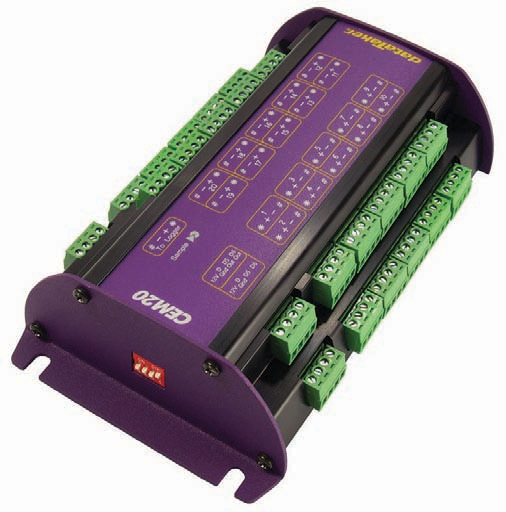
- Expandability: If 5 to 15 channels aren’t enough, it can be expanded up to 300 analogue inputs using DataTaker Channel Expansion Modules (CEM20).
- Digital I/O: Features 8 bi-directional digital channels, high-speed counters, and 1 latching relay output to trigger external alarms or control hardware.
Data Storage & Communication
The logger is designed to operate reliably in remote environments where consistent physical oversight isn’t possible.
- Massive Memory: Can store up to 10 million data points in its internal non-volatile memory, which can be configured to overwrite older data or stop logging once full.
- Connectivity: Equipped with RS232, USB, and Ethernet ports.
- Networking Protocols: Built-in Web and FTP client/server functionality allows it to automatically push data to an office server or email reports on a scheduled basis. It also supports Modbus (master/slave) for easy integration into SCADA systems and SDI-12 for environmental sensor networks.
Software & Usability
- dEX 2.0 Web Interface: The DT80G features a pre-installed, built-in browser interface. There is no proprietary software to install; you simply connect via USB or Ethernet, open a web browser, and configure your logging schedules, view live charts, mimic diagrams, or download CSV files.
- Calculated Channels: Allows users to program complex mathematical expressions, polynomials, and statistical calculations directly onto the logger so data is linearized and scaled before storage.
Physical & Environmental Specs
- Robust Construction: Housed in a powder-coated steel and anodised aluminium chassis.
- Operating Temperature: Extremely wide operational threshold from -45°C to 70°C (though the integrated LCD screen’s functionality reduces outside of -15°C to 50°C).
- Power: Highly power-efficient with internal battery options and smart sleep modes, making it ideal for solar-powered setups in remote areas like dams, tunnels, landslides, and open-pit mines.