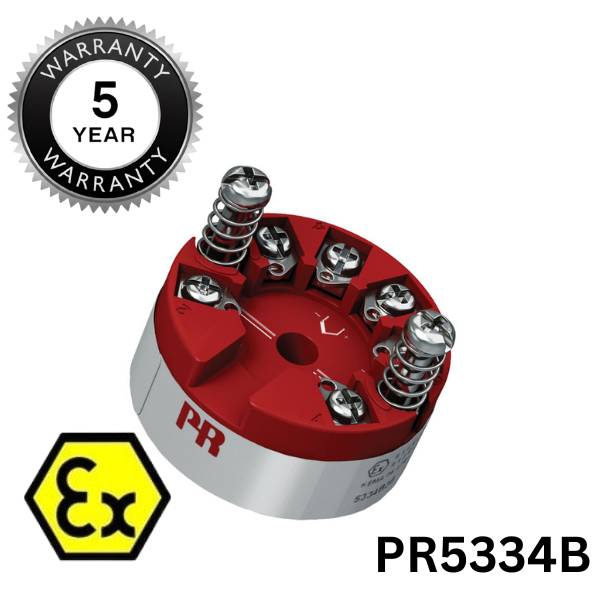
PR5334B Programmable ATEX Transmitter
The PR 5334B is an intrinsically safe, head-mounted 2-wire transmitter for thermocouple and bipolar millivolt measurements. It converts the selected input into a standard 4–20 mA output for compatible monitoring and control equipment. Designed for DIN form B sensor heads, it combines galvanic isolation, built-in cold junction compensation and programmable sensor error indication.
Thermocouple Temperature Measurement
The 5334B supports a range of thermocouple types, including commonly used J, K, N and T sensors. Its programmable input allows the thermocouple type and measurement range to be matched to the application.
The transmitter linearises the thermocouple signal so that the current output represents the configured temperature range. This allows suitable PLC inputs, indicators and data acquisition systems to receive the measurement through a standard current loop.
Built-In Cold Junction Compensation
Thermocouple measurements depend on both the measuring junction and the reference connection temperature. The 5334B uses a built-in temperature sensor to provide cold junction compensation at the transmitter.
This compensates for changes in the reference connection temperature as part of the thermocouple conversion. Correct thermocouple wiring and suitable extension or compensating cable remain necessary for the installation.
Bipolar Millivolt Signal Conversion
The 5334B also accepts supported bipolar millivolt inputs. It amplifies these low-level signals and converts them into a 4–20 mA output.
Configurable linearisation allows suitable millivolt measurements to follow a defined conversion relationship. This provides an option for compatible signal sources beyond conventional thermocouple temperature measurement.
Galvanic Isolation and Two-Wire Operation
Galvanic isolation separates the sensor input from the output circuit, with a specified isolation test voltage of 1.5 kVAC. The transmitter receives power through the same two-wire loop that carries the measurement output.
Installing the transmitter within the sensor head positions conversion close to the measurement point. The resulting current signal carries the measurement onwards to the receiving equipment.
Configuration and Sensor Error Indication
The 5334B is configured using PR Electronics PReset software and a compatible Loop Link interface. Settings include the input type, measurement range, response time and sensor error behaviour.
A programmable sensor error value provides a defined output response when a sensor fault is detected. Receiving equipment can use this response to identify a measurement problem and activate an appropriate indication or alarm.
Intrinsically Safe Installation
Hazardous-area approvals support installation within the model’s certification conditions. The transmitter must form part of a compatible intrinsically safe arrangement, including suitable associated equipment, sensor connections and enclosure.
Before selection, confirm the thermocouple or millivolt input, measurement range, loop requirements and applicable approval conditions. Where RTD or resistance inputs are also required, the 5331D provides a broader input alternative.
Options
| Type | Version | Ambient Temp. | Galvanic Isolation |
| 5334 | A: General Purpose, Zone 2, Div 2
B: Zone 0, 1, 2, 21, 22, M1/Div 1, Div 2 | 3: -40°C to +85°C | B: 1,500 VAC |