
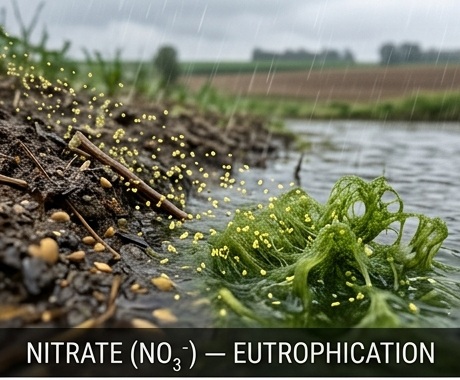
Nitrates (NO3-) are naturally occurring chemical compounds composed of Nitrogen and Oxygen. Found in almost all freshwater systems, they serve as a fundamental nutrient required for the growth of aquatic plants and algae. However, because Nitrates are highly soluble and bind easily with water, human activity can quickly overload natural aquatic systems, tipping the balance from a vital nutrient into a destructive pollutant.
Nitrate levels in rivers and inland water courses fluctuate constantly based on environmental inputs. These changes generally originate from two main pathways:
Left unchecked, elevated nitrate levels cause eutrophication, a process where excessive nutrients spark explosive, toxic algal blooms. As these massive blankets of algae die and decay, they consume all available dissolved Oxygen, leaving “dead zones” that choke out fish and other aquatic life.
Monitoring is essential because Nitrate spikes can manifest through two completely different timelines:
Regular, accurate monitoring provides the data baseline required to execute remediation strategies. By identifying exactly where and when Nitrate concentrations spike, environmental teams can trace pollutants back to their exact point source.
This data empowers authorities to enforce targeted solutions: adjusting agricultural zoning, establishing riparian buffer zones (planting vegetation along banks to absorb runoff), upgrading wastewater treatment infrastructures, or timing agricultural inputs around weather forecasts. Real-time data ensures that recovery efforts are working to bring the river back to its baseline health.
To reliably capture both rapid spikes and progressive shifts in nutrient loads, water resource managers turn to advanced instrumentation. Aquaread’s Ion Selective Electrodes (ISEs) offer a robust, direct method for measuring real-time Nitrate (NO3-) concentrations in the field.
The interchangeable, tool-free ISE sensors work in tandem with the core pH and temperature parameters of Aquaread’s flagship multi-parameter Aquaprobe units:
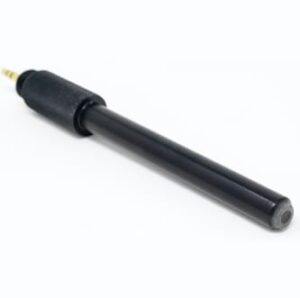
AP-2000 Nitrate Electrode with 2 Auto-Range scales 0-99.9 mg/L (ppm) or 100-29,999 mg/L (ppm). Accuracy ±10% of readings or 2ppm (whichever is greater). Minimum Level of Detection 0.5 ppm. The 2000-NIT is designed for use with the AP-2000 Aquaprobe sensor with pH probe.
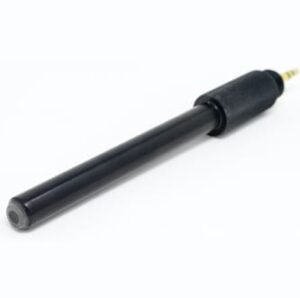
AP-5000 Nitrate Electrode with 2 Auto-Range scales 0-99.9 mg/L (ppm) or 100-29,999 mg/L (ppm). Accuracy ±10% of readings or 2ppm (whichever is greater). Minimum Level of Detection 0.5 ppm. The 5000-NIT is designed for use with the AP-5000 Aquaprobe sensor with pH probe.
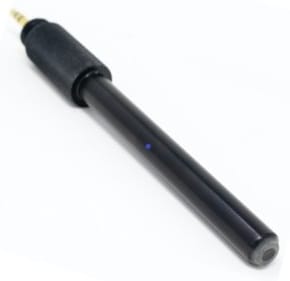
AP-7000 Nitrate Electrode with 2 Auto-Range scales 0-99.9 mg/L (ppm) or 100-29,999 mg/L (ppm). Accuracy ±10% of readings or 2ppm (whichever is greater). Minimum Level of Detection 0.5 ppm. The 7000-NIT is designed for use with the AP-6000, or AP-7000 Aquaprobe sensor with pH probe.
Nitrate rarely exists as an isolated issue. AquaProbe sensor’s include up to 6 auxiliary slots that allow you to deploy a highly customised array of alternative Ion Selective Electrodes concurrently. By tracking Ammonium (NH4+) alongside Nitrate, you can pinpoint whether pollution stems from fresh sewage/fertiliser (Ammonia) or older, oxidised runoff (Nitrate).
Adding Chloride (Cl-) tracks salinity and urban road salt spikes, Calcium (Ca2+) monitors changes in baseline water hardness, and Fluoride (F-) captures trace industrial chemical discharges. This comprehensive, multi-electrode approach transforms your Aquaprobe into a comprehensive catchment diagnostic tool.
A real person will answer the phone and deal with your enquiry.
You can also click the button below and fill in our online enquiry form.
Need help with your products or have a question for us on our custom systems? Use the form below to send us a message and our experts will be in touch to help.