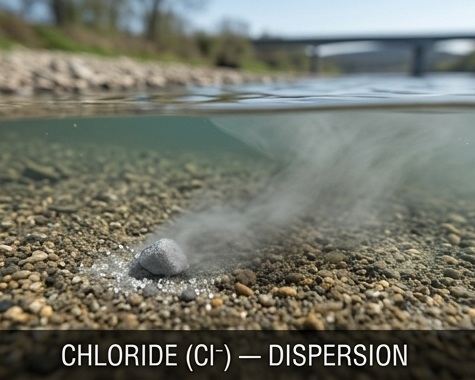
Chloride (Cl-) is a naturally occurring negative ion formed when the element Chlorine picks up an electron. It is a highly stable, non-reactive, and exceptionally soluble compound found in all natural waters. Under normal conditions, Chloride plays a vital role in maintaining the osmotic balance of aquatic organisms. However, because Chloride does not easily break down, bind to soils, or evaporate, human activities can easily cause it to accumulate to toxic levels, transforming this essential ion into a permanent environmental pollutant.
Chloride levels in rivers and streams shift based on the geography of the watershed and the surrounding human infrastructure:
While freshwater organisms can tolerate baseline salinity, elevated chloride levels are highly toxic to aquatic life. High concentrations disrupt the ability of fish and amphibians to regulate fluids, leading to reproductive failure, structural damage, and mortality. Furthermore, dense, salty water can settle at the bottom of lakes and slow-moving rivers, preventing natural seasonal churning and starving lower water layers of Oxygen.
Monitoring is critical due to the dual nature of Chloride pollution timelines:
Because Chloride cannot be easily filtered out of a river naturally, tracking its movement is the only effective way to mitigate its impact. Continuous real-time monitoring provides environmental management teams with the precise data needed to map pollution plumes back to specific highways, industrial outfalls, or agricultural zones.
With this data, authorities can implement targeted, preventative solutions: optimising Winter road maintenance strategies (such as pre-wetting roads with brine to reduce total salt use), mandate industrial zero-liquid-discharge systems, construct specialised stormwater retention ponds to capture and slowly release salty run-off, or adjust agricultural practices to minimise potash migration into local waterways.
To reliably capture both acute Winter road salt spikes and long-term groundwater salinity shifts, water resource managers rely on continuous in-situ data. Aquaread’s Chloride Ion Selective Electrodes (ISEs) provide a robust, direct method for measuring real-time Chloride (Cl-) concentrations directly in the field, eliminating the logistical delay of laboratory sampling.
.
Aquaread’s interchangeable, tool-free Chloride ISE sensors work alongside the core pH, conductivity, and temperature sensors across their multi-parameter Aquaprobe range:
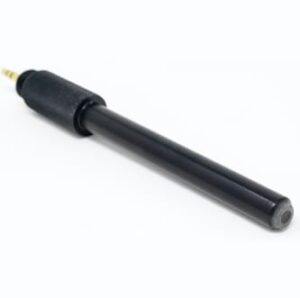
AP-2000 Chloride Electrode with 2 Auto-Range scales 0-99.9 mg/L (ppm) or 100-8,999 mg/L (ppm). Accuracy ±10% of readings or 2ppm (whichever is greater). The 2000-CHL is designed for use with the AP-2000 Aquaprobe sensor
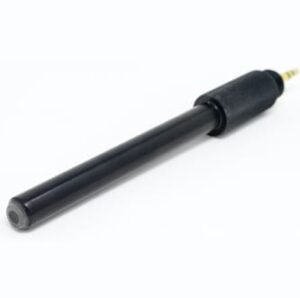
AP-5000 Chloride Electrode with 2 Auto-Range scales 0-99.9 mg/L (ppm) or 100-19,999 mg/L (ppm). Accuracy ±10% of readings or 2ppm (whichever is greater). The 5000-CHL is designed for use with the AP-5000 Aquaprobe sensor
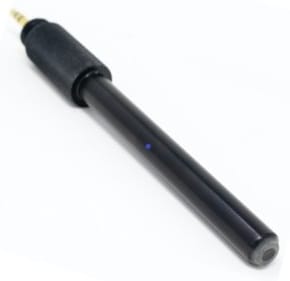
AP-7000 Chloride Electrode with 2 Auto-Range scales 0-99.9 mg/L (ppm) or 100-19,999 mg/L (ppm). Accuracy ±10% of readings or 2ppm (whichever is greater). The 7000-CHL is designed for use with the AP-6000, or AP-7000, Aquaprobe sensor
Salinity and runoff issues rarely involve just one chemical parameter. Aquaread’s multi-port auxiliary configuration allows you to deploy several Ion Selective Electrodes concurrently to gain a complete geochemical understanding of the watershed.
By tracking Calcium (Ca2+) alongside Chloride, you can differentiate between standard rock salt (NaCl) and industrial or premium road de-icers like Calcium Chloride (CaCl2). Concurrently adding Nitrate (NO3-) and Ammonium (NH4+) sensors lets you separate urban road run-off from agricultural fertiliser inputs or sewage leaks. This comprehensive multi-electrode approach transforms a single Aquaprobe into an all-in-one catchment diagnostic toolkit.
A real person will answer the phone and deal with your enquiry.
You can also click the button below and fill in our online enquiry form.
Need help with your products or have a question for us on our custom systems? Use the form below to send us a message and our experts will be in touch to help.