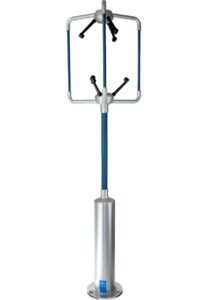
The Gill Instruments R3 range represents the absolute pinnacle of solid-state wind sensing, engineered specifically for high-speed scientific research and micrometeorological analysis. While standard industrial anemometers (like the 2-axis WindSonic or MaxiMet) are limited to measuring horizontal wind vectors on a flat plane, the R3 family utilizes a specialized, 3-dimensional array of ultrasonic transducers. This configuration captures the complete three-dimensional wind vector—simultaneously resolving horizontal speed, wind direction, and vertical turbulence (updrafts and downdrafts).
Operating at an ultra-fast 50 Hz or 100 Hz sampling rate, the R3 range can capture up to 100 complete wind data points every single second. This high frequency is critical for advanced micro-meteorology applications like Eddy Covariance flux measurements (tracking how greenhouse gases and heat move between the earth and the atmosphere) and structural wind tunnel testing. For researchers and engineers, this means the R3 doesn’t just tell you how hard the wind is blowing; it maps the microscopic, chaotic turbulence structures within the air column.

To ensure your data collection infrastructure matches your atmospheric environment, the R3 range scales across distinct physical and electronic configurations:
R3-50 & R3-100 (Symmetric Omnidirectional Head): These models feature an evenly spaced, 3-strut layout that provides true $360^\circ$ horizontal tracking. They are the ideal choice for generalized 3D turbulence profiling where wind vectors shift rapidly and unpredictably from any direction. The numerical designation dictates the maximum sampling speed (50 Hz or 100 Hz).
R3A-100 (Asymmetric Head): The “A” signifies an asymmetric arm design. This model physically shifts the structural support struts out of the way of the primary horizontal plane to minimize “flow distortion”—the subtle aerodynamic shadowing caused by the sensor’s own frame. It is the gold standard for high-precision boundary layer research over crops, soil, or water.
Expanded Analog Connectivity: Unlike the standard digital-only R3 models, the R3A-100 integrates a multi-channel electronics suite natively supplying 7 analog outputs (covering the U, V, and W wind vectors, speed of sound, and auxiliary inputs) alongside an optional built-in dual-axis inclinometer to instantly flag if your mounting mast has tilted in the field.
The R3 wind sensors have been designed for scientific research, particularly suitable for determining fluxes using the eddy covariance technique. This precision ultrasonic anemometer will monitor wind speeds up to 45m/s, with U, V, W and SOS (sonic temperature) outputs. The R3-50 has a fast data output rate of 50Hz, whilst the R3-100 has an ultra fast output rate of 100Hz. The R3-50 and R3-100 are an Aluminium/Carbon fibre construction and can operate effectively in environmental temperatures from -40°C to +60°C.
A real person will answer the phone and deal with your enquiry.
You can also click the button below and fill in our online enquiry form.
Need help with your products or have a question for us on our custom systems? Use the form below to send us a message and our experts will be in touch to help.