
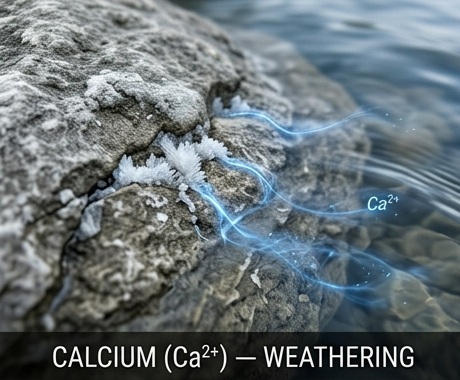
Calcium (Ca2+) is one of the most common and vital mineral ions found in freshwater ecosystems. It is a divalent cation that serves as a primary building block for aquatic life, essential for the skeletal development of fish, the shell formation of molluscs and crustaceans, and the cellular structure of aquatic plants. Calcium is also the principal component responsible for water hardness and controls the baseline buffering capacity of a water course. However, when human industrial processes or heavy agricultural treatments alter its natural concentration, it can destabilise the delicate chemical balance of a river.
Calcium concentrations in rivers and inland water courses fluctuate based on regional geology and land-use practices:
While Calcium is inherently beneficial and non-toxic at standard concentrations, extreme fluctuations can have cascading ecological effects. Drastic shifts in Calcium alter water hardness and pH balance, which can disrupt the osmoregulation (fluid balance) of fish and cause severe mineral scaling over submerged habitats.
Monitoring is necessary because Calcium levels follow two distinct operational timelines:
Because Calcium directly influences how other pollutants (like heavy metals) interact with aquatic life, tracking its concentration provides a vital baseline for environmental remediation. Continuous monitoring allows catchment managers to map outfall plumes and determine whether hard-water spikes are originating from industrial facilities or agricultural practices.
With precise real-time data, authorities can enforce effective management strategies: regulating the volume and timing of industrial discharges, optimising agricultural liming schedules to prevent storm run-off, establishing sediment basins near construction zones to trap cement wash, and adjusting water treatment processes to manage baseline hardness before it impacts sensitive downstream habitats.
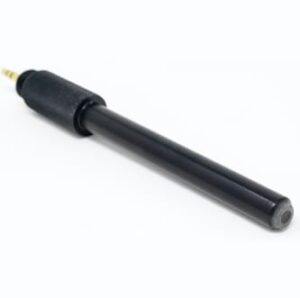
To reliably capture both sudden industrial discharge spikes and long-term geological hardening, water resource managers require accurate in-situ instrumentation. Aquaread’s Calcium Ion Selective Electrodes (ISEs) offer a direct, robust field method to measure real-time Calcium (Ca2+) concentrations, providing immediate data without the need to transport samples back to a laboratory.
Aquaread’s modular, tool-free Calcium ISE sensors integrate seamlessly into their multi-parameter Aquaprobe range, allowing you to track mineral hardness alongside standard metrics like pH, conductivity, and temperature:
AP-2000 Calcium Electrode with 2 Auto-Range scales 0-99.9 mg/L (ppm) or 100-1,999 mg/L (ppm). Accuracy ±10% of readings or 2ppm (whichever is greater). Minimum Level of Detection 0.05 ppm. The 2000-CAL is designed for use with the AP-2000 Aquaprobe sensor with pH probe.
AP-5000 Calcium Electrode with 2 Auto-Range scales 0-99.9 mg/L (ppm) or 100-1,999 mg/L (ppm). Accuracy ±10% of readings or 2ppm (whichever is greater). Minimum Level of Detection 0.05 ppm. The 5000-CAL is designed for use with the AP-5000 Aquaprobe sensor with pH probe.
AP-7000 Calcium Electrode with 2 Auto-Range scales 0-99.9 mg/L (ppm) or 100-1,999 mg/L (ppm). Accuracy ±10% of readings or 2ppm (whichever is greater). Minimum Level of Detection 0.05 ppm. The 7000-CAL is designed for use with the AP-6000, or AP-7000, Aquaprobe sensor with pH probe.
Geological and industrial water quality issues are rarely limited to a single parameter. Aquaread’s multi-port auxiliary configuration allows you to deploy several Ion Selective Electrodes concurrently to get a comprehensive, real-time chemical snapshot of the watershed.
By tracking Chloride (Cl-) alongside Calcium, you can immediately identify if a salinity spike is coming from Sodium chloride or industrial calcium chloride (CaCl2) discharges. Concurrently adding Fluoride (F-) allows you to analyze how water hardness influences fluoride solubility and toxicity to local fish. Meanwhile, combining these with Nitrate (NO3-) and Ammonium (NH4+) sensors lets you clearly differentiate between industrial chemical discharges and agricultural runoff. This comprehensive multi-electrode approach transforms a single Aquaprobe into an all-in-one catchment diagnostic tool.
A real person will answer the phone and deal with your enquiry.
You can also click the button below and fill in our online enquiry form.
Need help with your products or have a question for us on our custom systems? Use the form below to send us a message and our experts will be in touch to help.