Downloads
AP-7000 Water Quality Probe
Description
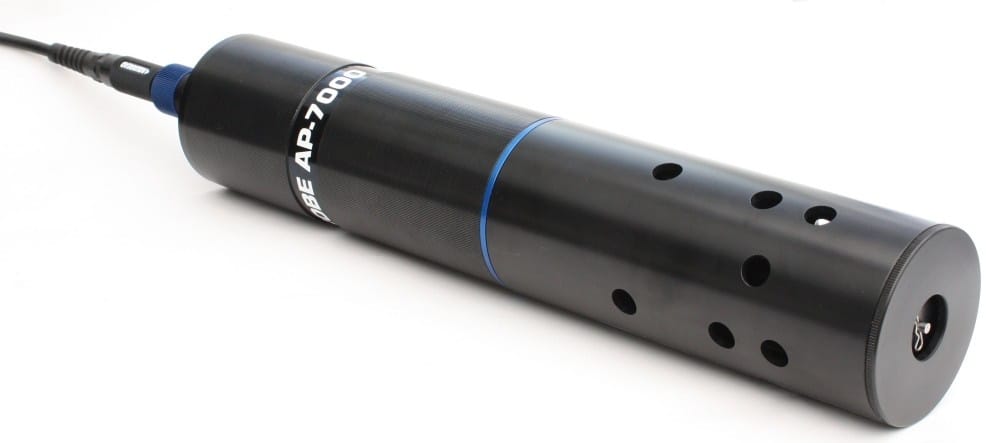
The basic AP-7000 Packages include an Aquaprobe AP-7000, a 3 meter cable, accessories and some RapidCal calibration solution all housed in a neat carry case for easy storage and transport. There are also packages available including an interface. The GPS Aquameter Display shows the readings from the connected AP-7000 probe.
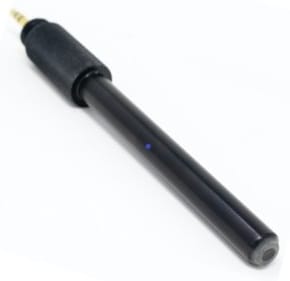
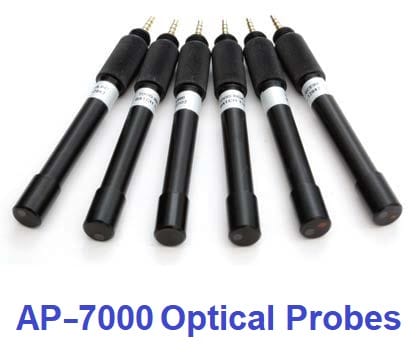
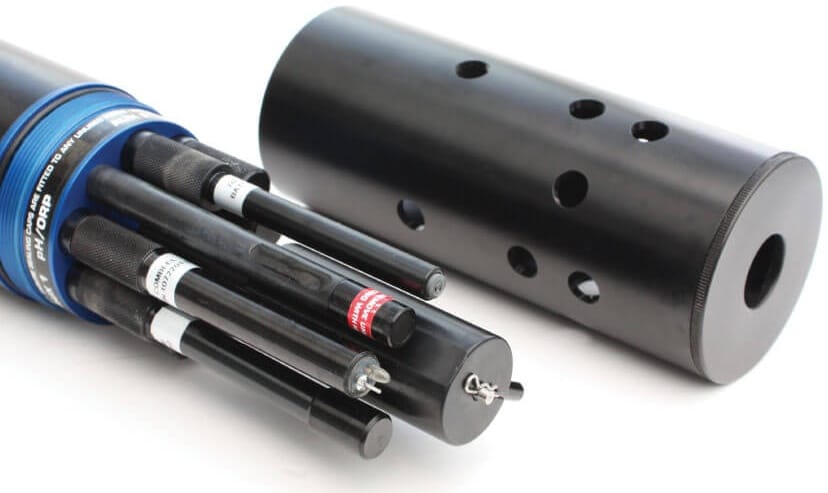
The Aquaprobe AP-7000 model is the largest sensor in the Aquaprobe range, including six Aux sockets with removable blanking covers, and feature a cleaning system that cleans all probes. A rotating arm in the centre of the probe, cleans the top of each of the installed probes and a wiper brush to clean the conductivity sensors on the side of the probe. This ensure the optical sensors are clear of air bubbles and the rest are clear of any bio-fouling common with any extended deployments. Any ISE or Optical sensors can be fitted to any of the six empty ports. Sensors supplied with the AP-7000 cover Water Depth, pH, ORP, Conductivity, TDS, SSG, Resistivity, Salinity, Dissolved Oxygen and Temperature, meaning the AP-7000 is capable of monitoring up to 17 parameters at once. The sensors are designed to be fully submerged in water and are rated to IP68, they are rated for continual immersion to a depth of 30 meters, and short term immersion (less than 12 hours) to 100 meters.
The Aquaprobe AP-7000-PACKAGE includes the base AP-7000 Package, plus the handheld GPS Aquameter display as the main interface. This unit will connect to the AP-5000 sensor and collect the readings it provides.
Self Cleaning System on the AP-7000 Probe
The removable central cleaning arm of the AP-7000 consists of a rotating set of brushes that clean all of the connected sensors, including the EC sensor located on the side of the optical DO probe. The cleaning arm, that features a small motor inside, can be easily unscrewed for maintenance, brush replacement and cleaning. Wiping the sensors regularly in this way can increase the deployment duration substantially, even in demanding environments.
Advanced Optical DO sensor
The optical sensor works on the principle of Dynamic Luminescence Quenching. A gas-permeable material known as a luminophore is excited with short bursts of blue light, which causes molecules in the luminophore to emit red photons. By measuring the delay of the returned red photons with respect to the blue excitation, the level of dissolved oxygen present can be determined.
The optical method has various advantages over the historical galvanic method for measuring dissolved oxygen.
The most important being that as no oxygen is consumed across a membrane, the sensor does not require a flow of liquid passing over it to achieve a stable reading. Other advantages include in frequent calibrations (every 3-6 months), and replaceable caps that last over 2 years
Specifications
| Parameters | Range | Resolution | Accuracy |
|---|---|---|---|
| Standard Parameters | |||
| Dissolved Oxygen | 0-500.0%/0-50.00mg/L | 0.1%/0.01mg/L | ±200%: ±1% of reading, 200% – 500%: ±10% |
| Depth Sensor | ±0-99.99m | 1cm | ±0.2%FS |
| Conductivity (EC) | 0-200mS/cm (0-200,000µS/cm) | 3 Auto-range scales: 0-9999µS/cm, 10.00-99.99mS/cm, 100.0-200.0mS/cm |
±1% of reading |
| TDS | 0-100,000mg/L (ppm) | 2 Auto-range scales: 0-9999mg/L, 10.00-100.00g/L | ±1% of reading |
| Resistivity | 5 Ω·cm-1 MΩ·cm | 2 Auto-range scales: 5-9999 Ω·cm, 10.0-1000.0 kΩ·cm | ±1% of reading |
| Salinity | 0-70 PSU/0-70.00 ppt (g/Kg) | 0.01 PSU/0.01 ppt | ±1% of reading |
| Seawater Specific Gravity | 0-50 σt | 0.1 σt | ±1.0 σt |
| pH | 0-14 pH/±625mV | 0.01 pH/±0.1mV | ±0.1 pH/±5mV |
| ORP | ±2000mV | 0.1mV | ±5mV |
| Temperature (non freezing) | -5 to +50°C | 0.01°C | ±0.1°C |
| Ion Selective Sensor (ISE) | |||
| Ammonium | 0-9,000mg/L (ppm) | 2 Auto-range scales: 0-99.99mg/L, 100-8,999.9g/L | ±10% of reading or 2ppm (whichever is greater |
| Ammonia | 0-9,000mg/L (ppm) | 2 Auto-range scales: 0-99.99mg/L, 100-8,999.9g/L | ±10% of reading or 2ppm (whichever is greater |
| Chloride | 0-20,000mg/L (ppm) | 2 Auto-range scales: 0-99.99mg/L, 100-19,999.9g/L | ±10% of reading or 2ppm (whichever is greater |
| Fluoride | 0-1,000mg/L (ppm) | 2 Auto-range scales: 0-99.99mg/L, 100-999.9g/L | ±10% of reading or 2ppm (whichever is greater |
| Nitrate | 0-30,000mg/L (ppm) | 2 Auto-range scales: 0-99.99mg/L, 100-29,999.9g/L | ±10% of reading or 2ppm (whichever is greater |
| Calcium | 0-2,000mg/L (ppm) | 2 Auto-range scales: 0-99.99mg/L, 100-1,999.9g/L | ±10% of reading or 2ppm (whichever is greater |
| Optical Probes | |||
| Turbidity | 0-4,000 NTU | 2 Auto-range scales: 0-99.9 NTU, 100-4000 NTU | ±10% of auto-ranged scale |
| Chlorophyll | 0-500.0µg/L (ppb) | 2 Auto-range scales: 0-99.99mg/L, 100-500.0g/L | ±5% of reading |
| Phycocyanin (Freshwater) | 0-300,000 cells/mL | 1 cell/mL | ±10% of reading |
| Phycocyanin (Marine BGA) | 0-200,000 cells/mL | 1 cell/mL | ±10% of reading |
| Rhodamine WT Dye | 0-500µg/L (ppb) | 2 Auto-range scales: 0-99.99µg/L, 100.0-500.0µg/L | ±5% of reading |
| Fluoescein Dye | 0-500µg/L (ppb) | 2 Auto-range scales: 0-99.99µg/L, 100.0-500.0µg/L | ±5% of reading |
| Refined Oil | 0-10,000mg/L (ppb) (Napthalene) | 0.1µg/L | ±10% of reading |
| CDOM/FDOM | 0-20,000µg/L (ppb) (Quinine Sulphate) | 2 Auto-range scales: 0-9,999.9µg/L, 10,000.0-20,000µg/L | ±10% of reading |