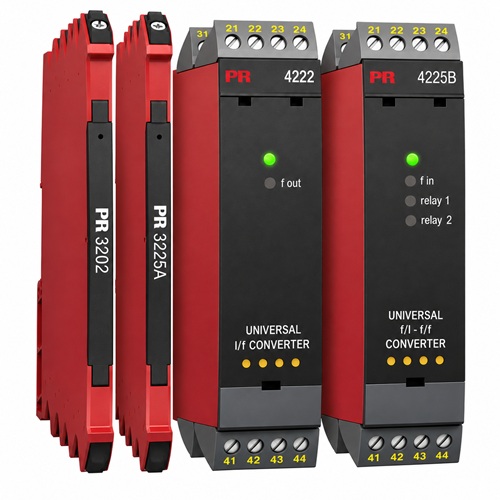
PR Electronics frequency and pulse converters connect sensors and instruments to monitoring and control equipment with different signal requirements. The range covers pulse isolation, frequency-to-current or voltage conversion, frequency scaling and analogue-to-frequency conversion. These functions allow measurements from compatible flow meters, speed sensors, switches and process transmitters to be used by PLCs, counters, displays and data acquisition systems.
Frequency and Pulse Signals in Industrial Measurement
Many sensors represent a measurement through the rate at which pulses occur. A flow meter may generate pulses in proportion to flow, while a speed sensor produces a frequency related to rotational speed. Receiving equipment must accept the sensor’s electrical output and interpret that signal correctly.
A suitable converter bridges differences between the sensor and control system. Depending on the model, it can provide an analogue measurement, adapt a frequency signal or isolate a switching output.
Frequency-to-Current and Voltage Conversion
Frequency converters translate a supported pulse or frequency input into a current or voltage signal representing the measured value. This allows equipment with analogue inputs to monitor sensors that provide digital pulses.
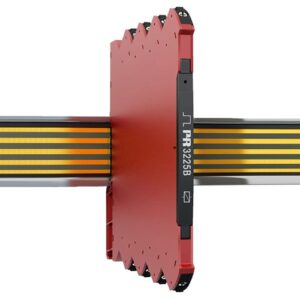
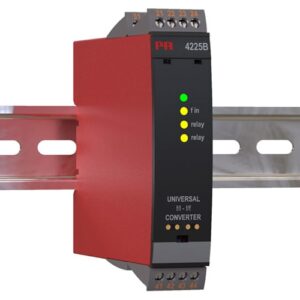
The PR 3225 and 4225 offer conversion options for several input types, including NAMUR, NPN, PNP, TTL, tacho, S0 and contacts. Available outputs and operating limits depend on the selected model and version.
Analogue-to-Frequency Conversion
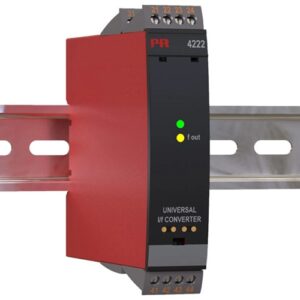
The PR 4222 performs conversion in the opposite direction, turning supported temperature, resistance, potentiometer, current and voltage inputs into a frequency output.
This suits installations where the receiving equipment requires pulses or frequency rather than an analogue input. Configurable NPN, PNP and TTL output options allow the electrical interface to be matched to compatible equipment.
Pulse Isolation and Switch Interfacing
The PR 3202 pulse isolator and switch amplifier interfaces supported NAMUR sensors, NPN open-collector signals and contacts with receiving equipment. Relay or transistor output versions accommodate different switching requirements.
Pulse isolation transfers switching information while electrically separating connected circuits. Choose this function when the requirement is to pass or interface pulses, rather than convert their frequency into an analogue measurement.
Frequency Scaling and Monitoring
Selected converters provide frequency output or relay functions alongside analogue conversion options. These allow suitable signals to be adapted for another frequency input or monitored against configured limits.
The required function determines the appropriate model: pulse isolation, frequency-to-analogue conversion, frequency adaptation or analogue-to-frequency conversion.
Selecting the Right Converter
Start with the sensor’s output type and frequency range, then identify the signal required by the receiving equipment. Check signal levels, pulse width, power supply, sensor supply requirements and electrical isolation.
The 3202 and 3225 provide compact options for control-panel installations, while the 4222 and 4225 offer universal AC/DC supplies and configuration through compatible PR 4500-series interfaces. Select the individual model and version to match the complete signal path.